
 Reading Time: 4 minutes
My Basic User Journey (BUJ) tool just got better. AI evolves the framework to prototyping UX design thinking directly from requirements. My BUJ just grew up!
What happened?
For work, I’ve created a Glean content agent that evaluates the chat input’s context, directs it to a specialist branch, and outputs a contextually formatted response. As an LLM, it can of course assist with researching design system guidance, evaluating and drafting UI copywriting and design, and more.
Having played with what LLMs can do in my home studio, I added a branch aimed at processing a full requirements document into my Basic User Journey (BUJ) design thinking tool. The result grabbed my attention. It demonstrated again just how powerful LLMs are when accessing their vast knowledge in support of our aims.
At home, I played with a custom Google Gemini AI assistant called a Gem to help make the BUJ tool more useful for my colleagues. The BUJ formalises and guides design thinking. It’s a useful framework for analysing enterprise requirements and planning the user experience.
The intention was to automate the analysis process and populate the BUJ table: a time-saver. The outcome exceeded my aims. The chat became a three-stage conversation drilling down to an HTML UI prototype with a working privacy feature—all within a matter of minutes.
The BUJ framework helps align thinking on how people use products and what problems our enterprise is solving. It breaks our transactions with consumers into six stages in parallel with enterprise constraints and opportunities. In table format, the BUJ focusses thinking around the following row headings for our persona and our enterprise:

- Wants
- Needs
- Tasks
- Input
- Output
- Review and Recycle
My BUJ Gem aced the evaluation and analysis of the documents fed to it and populated the table informatively. Some tweaks were needed to get the focus and volume of cell content right. I hadn’t expected Gemini to interpret “evaluate” to include outputting a critique of the work rather than only summarising it. Indeed, not only a critique—some solutions too. LLMs, what can I say?
What the LLM added
Following up in the chat allowed a progressive deep-dive into the design thinking of the smallest UI and content details too. Some of the output was a little over the top and given the poor quality documentation fed into it, it’s a stunning outcome.
Just the second proof of concept experiment turned my excitement dial to maximum.
I input a post from my UX Masters study pages. It outlined a privacy feature intended for a banking app. The Gem’s BUJ output correctly identified the issues we’d worked to solve and within two iterations of drilling into the BUJ consumer column of the input row, the Gem encoded an HTML prototype. It included a working privacy switch and obfuscation feature, and addressed design possibilities we’d not dealt with during our study.
The Gem output the HTML, JavaScript, and CSS needed to prototype the privacy switch concept embedded here.
Meanwhile, back at work
Back at work, I input an authentic product requirement document (PRD) into a new Glean Content Agent “BUJ” branch.
Over just three prompts and one BUJ drill-down into the User-Input cell, the agent returned a working, HTML prototype featuring selectable scenarios to demonstrate the experience. Impressive and, more importantly, possibly a useful filler between reading requirements and pixel-pushing.
The temptation is to fully automate the process and I am keen not to—other than for entertainment purposes. I believe we need to maintain the human-in-the-loop as design director and not a passive observer.
A new direction
This playtime Gem riff opens the opportunity to create a system that automates the transition from ideas to testing straight from the requirements. The goals for this workflow could include:
- Use raw persona data, accessibility guides, and content and design systems as sources.
- Create BUJ outcomes and functional HTML prototypes immediately.
This could help teams work faster while maintaining our humans in the loop. With the BUJ format, we keep the focus on solving problems for real people and our enterprise.
The potential is to test many, many different versions of an idea for different personas in the time it takes to draft one concept in Figma. Imagine the integrations with other emerging design tools.
The world has changed — and frameworks must change with it
The BUJ model is built for the world as it operates today and into the future: fast, cyclic, cross‑functional, and increasingly AI‑supported. It gives the clarity, structure, and universality that traditional frameworks can’t provide any more.
Legacy models were suited for slower, linear environments. They assumed predictable handoffs, specialist interpretation, and stable processes. Today’s reality is the opposite:
- AI needs clear structure and defined instructions.
- Services are continuous loops, not one‑off interactions.
- Teams need a shared language to cut across roles, departments, and sectors.
- Administrative complexity is a measurable cost centre, not an unavoidable inconvenience.
These pressures expose the limits of outdated linear frameworks:
- They add weight when teams need lift.
- They introduce friction where flow is essential.
- They fragment understanding at the very moment organisations need alignment.
The BUJ replaces this with a single, cyclic structure that mirrors how real journeys behave. It is simple enough for everyday use, powerful enough for strategic alignment, and structured enough for AI to reason with reliably.
Using JTBD?
The BUJ helps turn complexity into clarity without diluting accuracy.
When in place, Jobs‑To‑Be‑Done remains a valuable deep‑dive tool for understanding the forces behind behaviour, and it’s not the starting point. In a world that needs clarity first, JTBD becomes the companion layer — not the foundation.
The BUJ leads. JTBD enhances.
Conclusion
The future of design is about fast and intelligent updates and AI is a powerful partner for this BUJ way of design thinking.
The LLM capability gives the tool super-powers when evaluating requirements and identifying areas of design thinking to focus on while keeping the consumer persona at the center of our process. There’s certainly value in following up and developing this idea during playtime, and maybe at work too.
The essential infographic
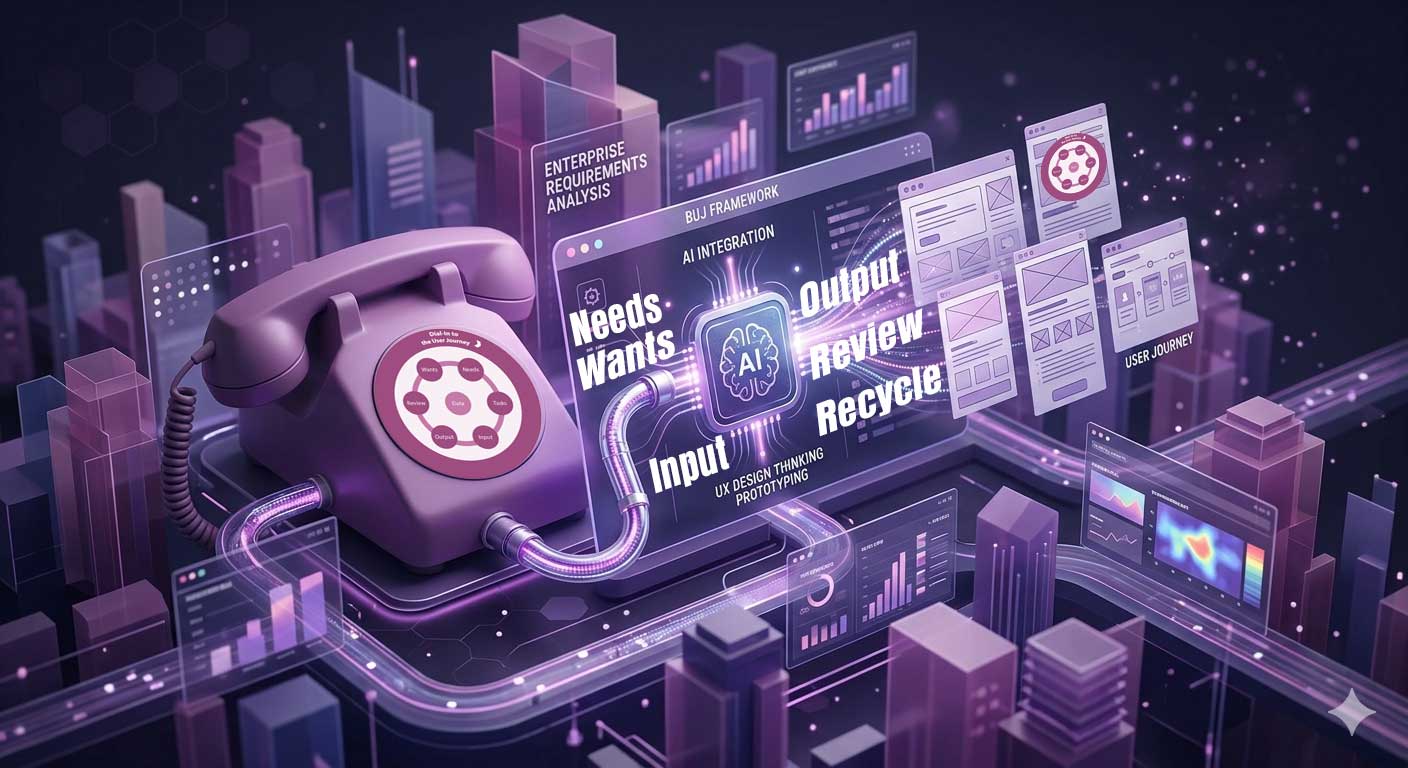
As much for my entertainment as your attention, the following is Google Gemini’s infographic summarising this post. Like all Ai output, it didn’t go without a little effort moderating its hyperbole.